 SilencerScout
Recoil System
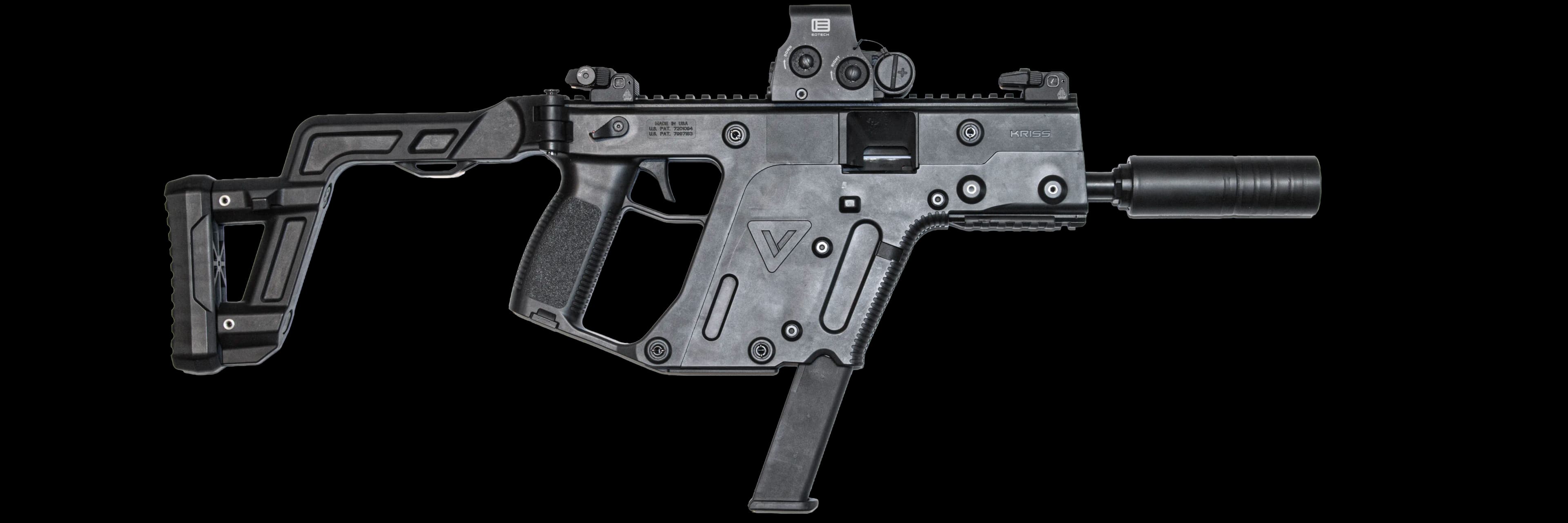
We cannot talk about suppressors before talking about the recoil mechanism that the suppressor is interacting with. The Vector uses an off-axis recoil mechanism to take energy that would have been wasted recoiling into the operator’s shoulder and redirect it downward to fight muzzle rise. The bolt has a transfer mechanism that slides down the vertical axis of the lower receiver. It’s a really novel system that I have not seen replicated anywhere but on the Vector. When introduced to the elevated backpressure of a suppressor, the Vector doesn’t yield a purely harsher “kick” into the shoulder. It changes how the muzzle moves.
The way I explain it: in a traditional semi-auto, you are fighting the muzzle to bring it back down. On the Vector, you are fighting a muzzle that wants to dance around its origin. I think this is what gives the Vector its “video game”-like recoil pattern. This recoil pattern is really why I enjoy shooting this platform, despite not getting the true full-auto experience that it deserves.
Suppressor
Let’s address the most fortunate amongst us first... the owner of a full-auto .45 ACP. A suppressor will change the recoil of the system, but the Vector is more than equipped to handle this. As I mentioned in the recoil section, this will result in a bit more movement, but good recoil control will be able to address it. The reason you really want a vented, low-backpressure can is that gas stacking will build up quickly with an unsuppressed cyclic rate of 1200 RPM. Get a low-backpressure can, move those gases forward, keep your cyclic rate closer to the design speed, and avoid gassing yourself out. I would also try to stick to cleaner-burning ammo to decrease the service schedule. There are a few good suppressor options for this task, with the Huxwrx Flow 45m, CAT SP, and Dead Air Mojave 45 being the first to come to mind. All of these are long suppressors, which I do not mind on this platform, as it is such a short, stocky platform. That said, the Hux and CAT both have short configurations that some users might prefer.
To speak to the semi-auto 9mm version that I have the most experience with, my suppressor recommendations will widen up a bit. My top choices will still be vented suppressors like the Huxwrx Flow 9kti, CAT SC/SC-S, Mojave 9, and similar. Low backpressure is always nice, but if you want to avoid the service schedules, or just want to save a few bucks, I have used an Omega 9k for years on my 9mm Vector. I could very well be habituated to its swift recoil impulse, so take my recommendation with a dose of skepticism. But the Vector was built with .45 ACP in mind, and the recoil system, while tuned for 9mm at the factory, seems to have the overhead for pressures above what the 9mm produces with regular-spec ammo. High-backpressure suppressors have very little effect on my ability to stay on target, and I tend to prefer the more dynamic recoil.
Vectors are a bit finicky on reliability, with user feedback not pointing to a clear ammo selection that works best. It seems each owner has their own ammo configuration that works with their specific serial number. I can speak to my experience on the 9mm Gen2. I had a few reliability issues when I did not have it well oiled or was shooting cheap ammo. In my 1 of 1 case, throwing a suppressor on it seemed to mitigate all jams. Knock on Wood.