 SilencerScout
Key Info
- —
More internal volume = more room for manufacturers to manage sound and backpressure.
- —
More size can add more weight and backpressure depending on how it was designed.
"No Replacement for Displacement"
Engines are the right analogy for understanding suppressors. In the car space, the saying is "there's no replacement for displacement." The most reliable way to add horsepower is to add engine volume. Likewise, the simplest way to add sound performance is to increase the internal volume of a can. But just as you won't find every race car sporting an unwieldy 15-liter semi-truck engine, you won't find a suppressor the size of a beer keg. See this video of someone using a line of car tires to suppress a gunshot.
Sure, the fastest car in the world will have a massive engine that tears up anything in a straight line, but the most useful, fun, agile, and effective cars for most drivers have the balance and size of a Porsche. A great can for most shooters will be one with a manageable amount of weight, weight that keeps the firearm maneuverable and low profile. One that uses its limited internal volume effectively and doesn't just redirect the blast forward into the range.
Lets also consider how we use internal volume. To play on the engine analogy one more time: as we get better at designing engines, we can squeeze more output from the same displacement volume. With suppressors, more advanced baffle geometry and greater mastery of fluid dynamics let a small printed can beat out the titans of the early 2000s.
ConsiderHow is a larger can using it's volume? Is it adding intelligent geometry or is wasting space?
Traditional baffle stacks and length.
Before the advent of additive manufacturing there was the machined baffle stack, be it welded, milled or whatever. With these designs there was some directional trends we could observe. Each additional baffle, was one more speed bump gas had to overcome to escape to the atmosphere, and as a baffle was added, sound signature was reduced. But with each new baffle acting as a speed bump, the new baffle would increase the backpressure imparted on the the host firearm. A longer can, traps gas longer, and on a semi-auto host, some of that trapped gas would escape back through the ejection port and near the shooters face.
The challenge with these designs was adding length that added enough sound performance to justify the backpressure and weight. As you keep adding baffles the sound performance would begin to fall of, that is, each new baffle would improve sound performance less than the one before it. But each baffle would add the same weight. For a static shooter, on a bolt action, the point of diminishing returns was met at a higher baffle count as they care nothing of backpressure and a heavy weight can be managed. For the semi-auto competition shooter, a small low baffle count suppressor was sought out for a lower backpressure, lighter, but louder experience.
Additive manufacturing changing the game.
Our equation for the traditional machined baffle stack, +1 baffle = less noise + more weight + more backpressure, gets discarded. We can now print cans with advanced channels that traverse the outside of the baffle stack, that redirect gas out the front of the muzzle instead of back into the action of the firearm. The old linear equation of more baffles = more backpressure no longer holds. We still have weight and its consequences to worry about, but we'll cover that in another chapter.
Does a larger printed can have more backpressure? Not always. The relationship between length and backpressure varies between manufacturers, and even between suppressors in the same family, and not in a linear fashion. Ridgeback Defense advertises their larger Rhodie 6 as having less backpressure than their smaller Rhodie 6K. They have this control because they can dictate how much gas escapes through their low backpressure channels. By restricting flow through those channels in the K version, they force more gas through the traditional baffle stack to compensate for the can's reduced internal volume. Put another way: Ridgeback used the extra real estate of the full-size Rhodie 6 to cut backpressure rather than to squeeze out a few more decibels. Not every manufacturer makes that call. Some keep the flow rate high in their K cans, holding backpressure steady at the cost of sound performance.
Figuring out which design decisions were made gets confusing fast, and we're often at the mercy of what manufacturers are willing to disclose. Some are transparent about the characteristics and compromises baked into their designs. Others will tell you their can is perfectly optimized for every size, pressure regime, and environment. Our goal is to cut through that and show you what you're actually paying for.
ConsiderSome of the new machined baffle stack's have been able to create low backpressure channels using the older manufacturing methods. LPM Torch being a good example.
Related Products
Volume by diameter.
In our no-replacement-for-displacement logic, we can add volume by adding length or by giving the can a larger diameter. Diameter is easy to overlook as a variable, since most manufacturers differentiate SKUs by adding length rather than varying diameter.
The design advantage of a larger diameter is that you can add volume without adding length to the gun. This is great for maximizing sound performance and avoiding turning your can into a musket. In traditional baffle stacks, a shorter, fatter can may also produce less backpressure than a longer, skinnier one of equal internal volume, because the bullet spends less time inside the suppressor. This matters less on modern printed cans but remains relevant on some value options like the YHM Fat Cat. Diameter is how a suppressor like the Stealth Additive Works Tisha can be one of the quietest cans on the market at only 4.5" in length.
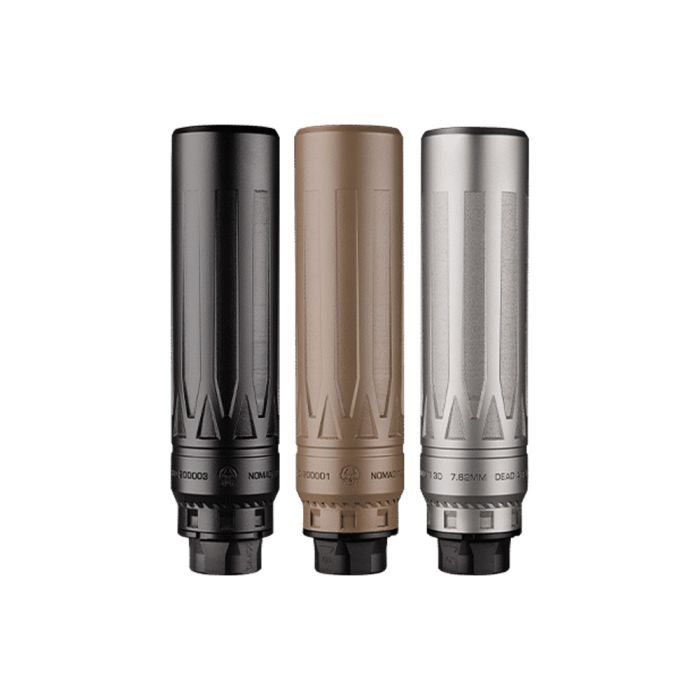
Large-diameter cans have not seen mass adoption for a few reasons. The most relevant is that, at a given wall thickness, a smaller-diameter cylinder has significantly more pressure-handling capacity. Hoop stress in a pressurized cylinder scales linearly with radius, so doubling the bore diameter doubles the stress the tube wall sees from the same pressure. Matching the strength of a slim can therefore requires thicker walls, premium alloys, or both, which drives up weight and cost while eating into the internal volume that was the whole point of going bigger. This is why many military cans like the Surefire RC4 use a slender 1.5" diameter, while a popular and still durable option like the Dead Air Nomad 30 XC might use a 1.76" diameter.
Large diameter also creates form-factor problems. A can wider than the handguard will contact a shooting surface before the handguard does, deflecting the barrel when rested on something like a car hood. Not a common issue, but for a select few it's a dealbreaker. Users hoping to tuck the suppressor under a handguard run into the same wall.
Pros
More diameter = More volume with added less length
Less artificial dwell time.
Weight is closer to the shooter.
Cons
More diameter = More weight per inch
Reduced Hoop Strength.
Potential interference with shooting platforms.
Less compatibility when tucked under handgaurds..
Related Products

Cylinder scaling: wall thickness for constant hoop stress
For a thin-walled tube holding pressure P, hoop stress σ = P·r / t. To keep σ constant as the tube grows in diameter, wall thickness must scale linearly with diameter. Baseline: 1.50″ × 4″ tube with 0.060″ walls. This model covers the outer shell only — mount, baffle, and end cap weights are not included.
Weight and Barrel Harmonics
Besides the obvious, size adds weight and weight makes things heavy, a suppressor with added mass can affect the harmonics of a barrel.
Every barrel vibrates when a round goes off. The pressure spike, the bullet's passage through the bore, and the release of gas at the muzzle all set the barrel oscillating. The muzzle whips through a small arc during the few milliseconds the bullet is still in the bore, and where it's pointing at the moment the bullet exits determines, in part, where that bullet lands.
Hang a suppressor on the end of that barrel and you've changed the system. The added mass lowers the natural frequency of the barrel's vibration and dampens the amplitude of those vibrations, because the inertia of the suppressor resists the motion the barrel wants to make.
For the shooter, this shows up in a few ways. Point of impact almost always shifts when a suppressor is added or removed, sometimes by inches at 100 yards. Group size can change as well, often for the better since a heavier muzzle is a more stable muzzle, but not always. A barrel that was tuned to shoot well bare may shoot worse with a can hanging off it, and vice versa.
Barrel contour matters here. A pencil-thin sporter barrel is far more sensitive to muzzle mass than a heavy bull barrel. Adding a 20-ounce suppressor to a 16-inch pencil barrel is a much larger proportional change than adding the same can to a heavy-profile target barrel. This is one reason precision shooters often prefer heavier contours when shooting suppressed: there's less for the suppressor to disturb.
None of this means a suppressor will ruin your accuracy. The effect is usually small, predictable, and easily compensated for with a quick zero confirmation. But it does mean that "shoots well bare" and "shoots well suppressed" are two separate claims about a rifle, and treating them as the same can lead to frustration at the range.
ConsiderHeavier suppressor's increase your POI shift.
ConsiderBarrel shape plays a roll in POI shift.
So what do I want?
Size philosophy is highly subjective, and the user ultimately needs to decide how they want to balance size, weight, length, sound, and backpressure. Have some fun mulling through the principles we discussed above and conceptualize good use cases for each scenario. Here are some common arguments I have seen people make to help seed some thoughts:
I have a long gun with a long barrel:
My gun is already long and relatively quiet, so I want a small can that won't make it unwieldy. A long, super-quiet can is past the point of diminishing returns here.
My gun is already long, so why not add a long can and get an insanely quiet setup. I wasn't going to hike with this thing anyway.
I have a short gun with a short barrel:
My barrel is short, so the concussion and sound are massive. I need a big can to tame it.
My gun is short, and I don't want a large can making it long again. I already made my compromise with a short barrel, so I just want something to curb the noise and concussion that came with it.
More from Basics
- Understanding Sound and SuppressionWe will cover sound as it is perceived by the human ear, how this can be deceptive when considering hearing damage, and what do people mean when they talk about "tone".
- Suppressor MaterialsExploring the nuanced topic of suppressor materials.
- Barrel Length Restrictions for SuppressorsEvery can has its limit. Run it too fast, too hot, to high a pressure and it will break. In this article, we will cover the complexities of the 'too high a pressure' scenario and explain how the title "no barrel length restrictions" might be a tad misleading.